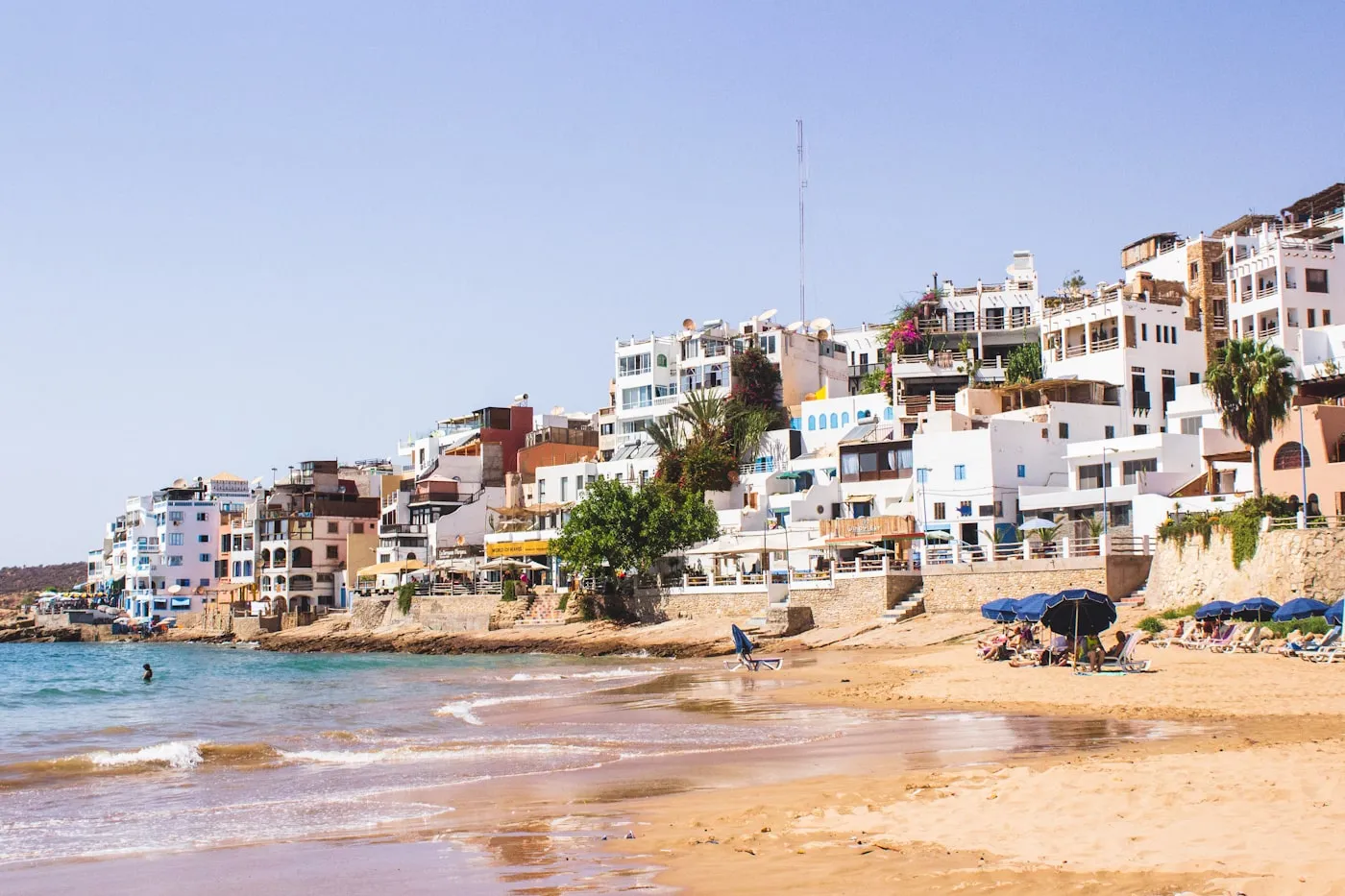
How far south is Taghazout, and how long is the drive?
Taghazout lies south of Imsouane on the same Atlantic coast road, a little short of Agadir. Agadir is about two hours from Imsouane Bay, and Taghazout sits roughly half an hour before it — so allow around an hour and a quarter to an hour and a half each way, longer if you stop at Tamri or meet traffic near Aourir.
That drive shapes the whole day. Mornings are usually the cleanest window on this coast and onshore wind tends to build after midday, so surfing Anchor Point in good shape means leaving before it is light, surfing one session, and driving home into the wind. Be honest about the arithmetic: a day trip south is one good session and roughly three hours in a car.
What is Anchor Point actually like?
Anchor Point is a right-hand point break at the northern end of Taghazout, breaking over rock and boulder. When a solid north-west swell arrives, the sections link up and it produces the long, fast, walling rides that put Moroccan surfing on the map.
It is not a forgiving wave. The take-off sits at the top of the point, the bottom is hard, getting in and out usually means picking a line across boulders, and the line-up is busy whenever the wave is on — during a good winter swell it can be one of the most crowded waves in the country. Point etiquette is not optional there: the surfer deepest at the top has the wave, and a drop-in is noticed immediately.
It also wants size. Below a decent swell the point runs slow and disjointed, and you will have driven ninety minutes for something weaker than what was breaking at home. That is the comparison worth keeping in mind. Magic Bay peels over sand for much of its roughly 800-metre length, which is exactly why it forgives mistakes. Anchor is a similar shape of wave with consequences attached.
What else is down there?
More than fifteen surf spots sit between Imsouane and Agadir, so Anchor is rarely the only card to play. Hash Point breaks in front of Taghazout village itself and handles smaller swell. Further south towards Aourir, Panoramas and Banana Beach are gentler, and much of the region’s teaching happens there. North of Taghazout, Killer Point and Boilers are rock-bottom waves that want real size and light wind. And Tamri, between us and Taghazout, is an exposed beach break that picks up more swell than almost anything on the strip — often the answer on a small day, and a shorter drive.
How do the spots compare?
| Spot | Bottom | Suits | Swell it wants | Drive from Imsouane |
|---|---|---|---|---|
| Magic Bay, Imsouane | Sand for much of its length | Beginners to experienced | Works across a wide range | About five minutes on foot |
| Cathedral Point, Imsouane | Rock | Experienced surfers | Moderate to large | Same village |
| Tamri | Sand | Intermediates; good on small days | Small to moderate | About 1 hour |
| Boilers / Killer Point | Rock | Experienced surfers | Large, with light wind | About 1 to 1.5 hours |
| Anchor Point, Taghazout | Rock and boulder | Confident intermediates and up | Solid north-west swell | About 1.25 to 1.5 hours |
| Hash Point, Taghazout | Rock and sand | Intermediates on smaller days | Small to moderate | About 1.25 to 1.5 hours |
| Panoramas / Banana Beach | Sand, some rock | Improvers and lessons | Small to moderate | About 1.5 hours |
When is the trip worth it — and when is it not?
Go when a solid north-west swell is running (most consistent September to April, biggest December to February), when you are a confident intermediate or better and comfortable over rock and in a crowd, and when you are happy to build the rest of the day around Agadir, the souk, or simply the drive.
Stay when the swell is small, which is most of May to August — the southern points need size, and on a small day the sand at home will give you more waves than the rocks down there. The same applies if the forecast has onshore wind by mid-morning, or if you are still learning: another session in the bay will do more for your surfing than three hours of driving.
How do you get there?
| Option | Flexibility | Relative cost | Worth knowing |
|---|---|---|---|
| Shared grand taxi | Low — leaves when full | Lowest | Fine for a one-way hop; little use if you want to chase a tide. |
| Local bus or shared van | Low — loose timings | Lowest | Boards are not always welcome; allow slack in both directions. |
| Chartered grand taxi | High | Moderate | Agree the fare and the waiting time before you leave, not afterwards. |
| Hire car | Highest | Higher | Lets you follow the forecast; parking at the points is informal. |
| 4x4 spot-chasing on our Surf Development Week | Destination chosen from the forecast | Included in the week | Where we go depends on swell and wind on the day. |
Whatever you choose, settle the fare in advance. Prices move with the season, the time of day and whether boards go on the roof, so the one rule that always holds is to agree it before setting off. Don’t leave anything visible in a parked car at the points.
What to take for a day on the points
The water down there is much the same as at home — roughly 17-20°C in winter and 20-23°C in summer — so a 3/2 wetsuit covers most of the year and a 4/3 is comfort in mid-winter. Booties are worth packing for rock entries and exits. Bring more board than you would take to a beach break, since length and rail help on long walls, plus water, food and cash, as card payment in the smaller villages can be patchy.
If you would rather build a week around this coast than one wave, our surf weeks run from the bay in Imsouane, and the Surf Development Week includes small-group coaching, video analysis and spot-chasing by 4x4. Daily lessons are capped at five surfers in the water, board and wetsuit rental is available daily or weekly if you are travelling without kit, and the activities side covers Paradise Valley, sandboarding and the Agadir souk. Anything we have not set out here — timings, what a particular trip involves, what fits your dates — we confirm with you directly on WhatsApp or by email, usually the same day.