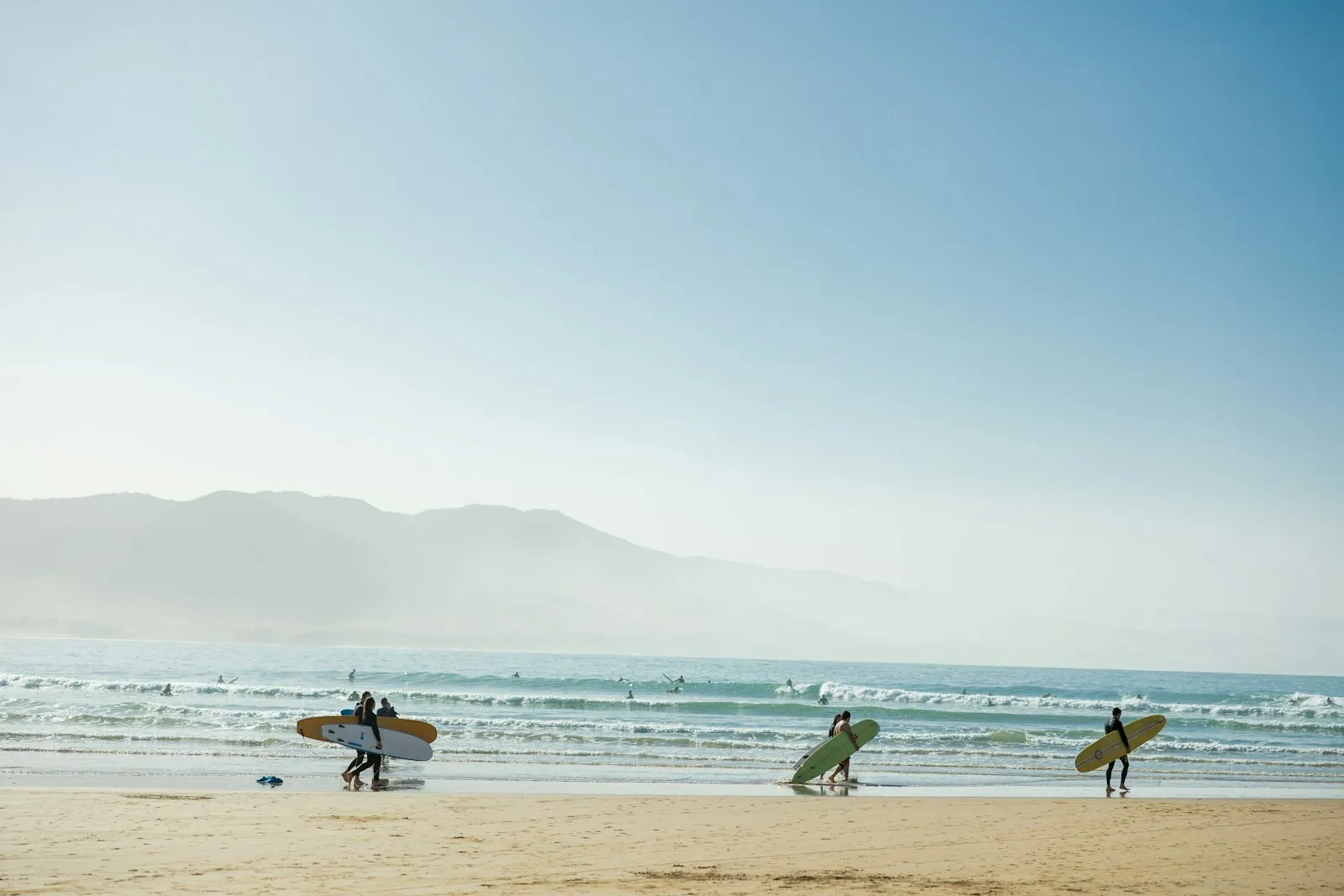
Do you need to be a strong swimmer to surf?
No, but you do need to feel at home in the water. Learning to surf is much less about swimming lengths and much more about staying calm when a wave knocks you off your board. For most new surfers, being comfortable in the water matters far more than speed or stroke technique.
Surfing schools generally don’t expect beginners to be confident open-water swimmers. They do expect you to cope with a few seconds underwater, come up without panicking and get back to your board.
What swimming level do beginners actually need?
This is a rough guide to what’s realistic at different levels of comfort in the water. It’s general advice, not a formal test.
| Your comfort in water | What’s realistic | What helps most |
|---|---|---|
| Can’t swim, nervous in water | Speak to the coaches before booking; some time in a pool first is wise | Pool sessions, learning to float and putting your face in the water |
| Can swim a little, calm in the shallows | Beginner lessons in waist-deep whitewater | Small groups, a big foam board, small summer swell |
| Can swim short distances confidently | Comfortable beginner progression | Regular lessons and building paddle fitness |
| Strong, confident swimmer | Faster progression to unbroken waves | More time in the water, then coaching on technique |
If you can float, hold your breath briefly and swim a few metres without grabbing for something, you’re usually ready for a beginner lesson.
Why does surfing feel different from swimming?
As a beginner, you spend most of your time lying on or standing next to a large board, not swimming. A soft-top beginner board is long, wide and very buoyant, and the leash keeps it tied to your ankle. After a fall, the board is never more than a leash-length away.
Wetsuits add a little buoyancy too. At Imsouane the water is roughly 17-20C in winter and 20-23C in summer, so a 3/2 wetsuit covers most of the year. Boards and wetsuits are included in our lessons.
The hard part for weaker swimmers is usually psychological, not physical: the moment of being tumbled by whitewater. Learning to relax, cover your head and wait a second or two before you surface makes everything easier.
How do lessons keep weaker swimmers safe?
Good beginner coaching is mostly about controlling the conditions. In practice, that means:
- Shallow water first. Beginners usually learn in the whitewater on the inside, often where they can stand.
- Small groups. Our group lessons are capped at five surfers, so the coach can keep every student in sight.
- Qualified coaches. Our coaches are ISA-certified and compete at home and abroad.
- Forgiving equipment. Beginners ride soft-tops on a leash, which are both buoyant and soft.
- Choosing the right moment. Mornings are usually cleanest, and the onshore wind tends to pick up after midday.
You only head out to unbroken waves once you’re paddling well and feel ready. There’s no set timetable for it.
Why does Magic Bay suit nervous swimmers?
Magic Bay, in Imsouane, is a long right-hand point break, roughly 800 metres long. It peels over sand for much of its length, so falling off is gentler than over reef or rock. It’s unusually forgiving and suits beginners as well as experienced surfers.
Cathedral Point, on the exposed side of the headland, is a different story. It’s more powerful and breaks over rock, so it isn’t a place for weaker swimmers.
When is the ocean calmest for learning?
The time of year makes a big difference if you’re anxious in the water.
| Months | Swell at Imsouane | Suitability for weaker swimmers |
|---|---|---|
| May to August | Smallest | Best time to learn |
| September to November, March to April | Most consistent, moderate | Good, but choose your days |
| December to February | Biggest and busiest | Better suited to experienced surfers |
Within each day, the morning is usually the best time: the water is cleaner before the onshore wind builds.
Which lesson format suits a weaker swimmer?
| Lesson | Length | Group size | Best for |
|---|---|---|---|
| Group lesson | 2 hours | Up to five | Confident beginners who enjoy company |
| Semi-private | 2 hours | Two to three | Friends or couples who want more coach attention |
| Private coaching | 2 hours | One-to-one, with video analysis | Nervous swimmers who want full attention |
| Kids lesson | 1h30 | Children from age six | Young beginners |
The fewer people per coach, the more attention you get, and that’s often what helps a nervous swimmer relax.
What should you tell your coach?
Be honest about your swimming when you book, and again on the beach. Coaches would far rather know you’re nervous than discover it in the water. We speak English, French, German and Arabic, so you can explain it in whichever of those you’re most comfortable with.
If you have any medical condition that affects you in the water, mention it too. We confirm the details directly when you book, and you can reach us through the contact page.
Where to go from here
To compare lesson formats in more detail, see our surf lessons. If you’d like a slower, fuller week in the water, take a look at our surf weeks. Already confident and just need gear? Have a look at board and wetsuit rental.