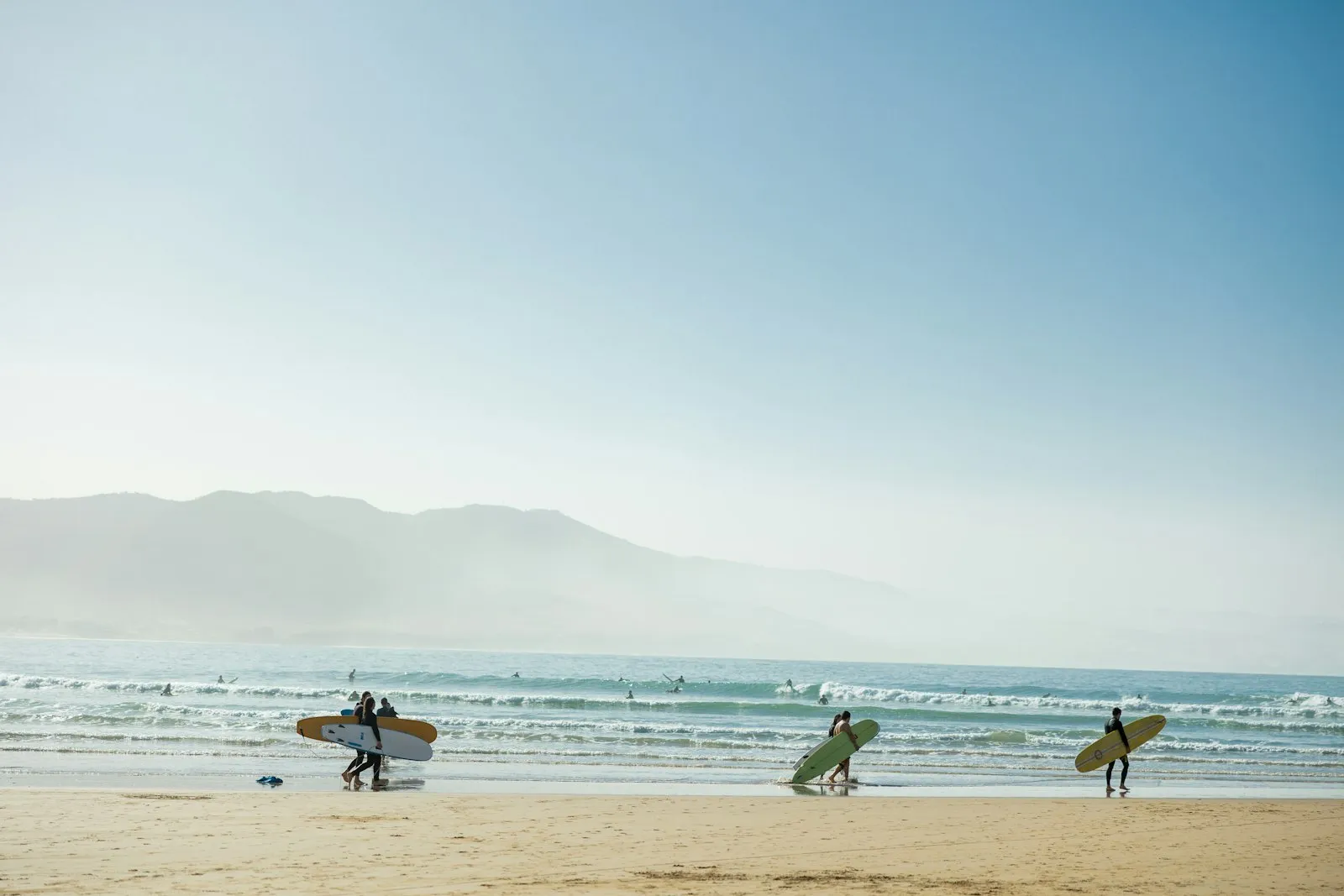
What is Cathedral Point?
Cathedral Point is the wave on the exposed side of the headland at Imsouane, on Morocco’s Atlantic coast in Souss-Massa. Magic Bay sits tucked inside the bay on the other side of that same headland. Cathedral faces the open ocean, and it breaks over rock rather than sand.
Most people arrive in Imsouane for the bay and hear about Cathedral on day two. It is worth understanding the difference before you paddle out, because the exact thing that makes Magic Bay so unusually forgiving - sand beneath a long, tapering right-hander - is the thing Cathedral does not have.
How does Cathedral Point differ from Magic Bay?
Both spots pick up the same north-west Atlantic swell. The headland is what separates them: by the time a swell has wrapped into the bay it has given up some of its energy and lined itself into a long, even wall, while Cathedral takes that same swell closer to full strength.
| Magic Bay | Cathedral Point | |
|---|---|---|
| Position | inside the bay, sheltered by the headland | exposed side of the headland |
| Bottom | sand for much of its length | rock |
| Character | long, tapering right-hand point break | usually shorter, steeper, more powerful |
| Suits | beginners through experienced surfers | confident intermediates and above |
| A fall | usually soft, into sand and open water | rock underneath, so falls have to be managed |
| Board | anything from a soft-top upward | a board you can commit on for a steep drop |
| Crowd | the main draw in Imsouane, busiest December-February | usually fewer people, because fewer surfers take it on |
How much experience does Cathedral Point demand?
The honest answer is: enough that you are not asking. More concretely, before Cathedral is a reasonable idea you want to be able to do all of the following without thinking hard about them.
- Paddle out unassisted, timing your exit between sets.
- Get through broken waves reliably, whether you duck-dive or turtle roll.
- Make a steep, late drop and set a line along the wall instead of going straight.
- Read a set from outside and move to the right spot before it arrives.
- Stay calm through a hold-down and surface without panic.
- Get yourself back in with a broken leash.
If two or three of those are shaky, the bay is the better session - and not as a consolation prize. Magic Bay is one of the more generous point breaks you will find anywhere, and the hours logged there are exactly what eventually makes Cathedral surfable.
What does a rock bottom change?
Sand moves when you hit it. Rock does not. That single difference reshapes the whole session.
Entry and exit are often harder than the surfing. Getting on and off a rock shelf with swell running takes timing, and it is where most injuries at rock spots happen.
Falls become a skill. Landing flat, covering your head, and coming up with an arm raised are habits you build deliberately.
Tide matters more. Over sand, tide is mostly a question of shape. Over rock it also changes how much is underneath you.
Small cuts are routine. Urchins and sharp edges come with the territory at rock breaks, so booties are worth packing.
Go with someone who has surfed it before, at least the first time. Where to get in and out is the part you cannot read from the beach.
When should you come?
North-west swell is most consistent from September to April. December to February brings the biggest and busiest conditions, when Magic Bay is at its best and Cathedral is at its most serious. May to August is the smallest stretch, which is why it is the best window for learning - and also a sensible time to stand on the headland and study Cathedral while it is manageable.
Mornings are usually the cleanest along this stretch of coast; onshore wind tends to build after midday.
| Months | Swell | Water | What that means at Cathedral |
|---|---|---|---|
| Sep-Nov | building, consistent | around 20-23°C, cooling through | often the sweet spot: real swell, fewer people |
| Dec-Feb | biggest and busiest | around 17-20°C | experienced surfers only on the bigger days |
| Mar-Apr | still consistent, easing | around 17-20°C | size without peak-season numbers |
| May-Aug | smallest | around 20-23°C | quietest, and a fair time to learn the layout |
A 3/2 wetsuit covers most of the year here.
How do people usually work up to it?
Almost nobody’s first Cathedral session is their first Imsouane session. The normal path is weeks in the bay, learning how a point break lines up, how the wind turns at midday, and where the current runs - then a look at Cathedral on a small, clean morning with someone who knows the entry.
If you are building toward that, our daily surf lessons and week-long surf camps are based around Magic Bay, where the long sand-bottom right does most of the teaching for us; boards and wetsuits are included. If you already surf and only need equipment for the trip, see board and wetsuit rental. For flat spells, we run Moroccan cooking, sandboarding, surf-skate, Paradise Valley and the Agadir souk.