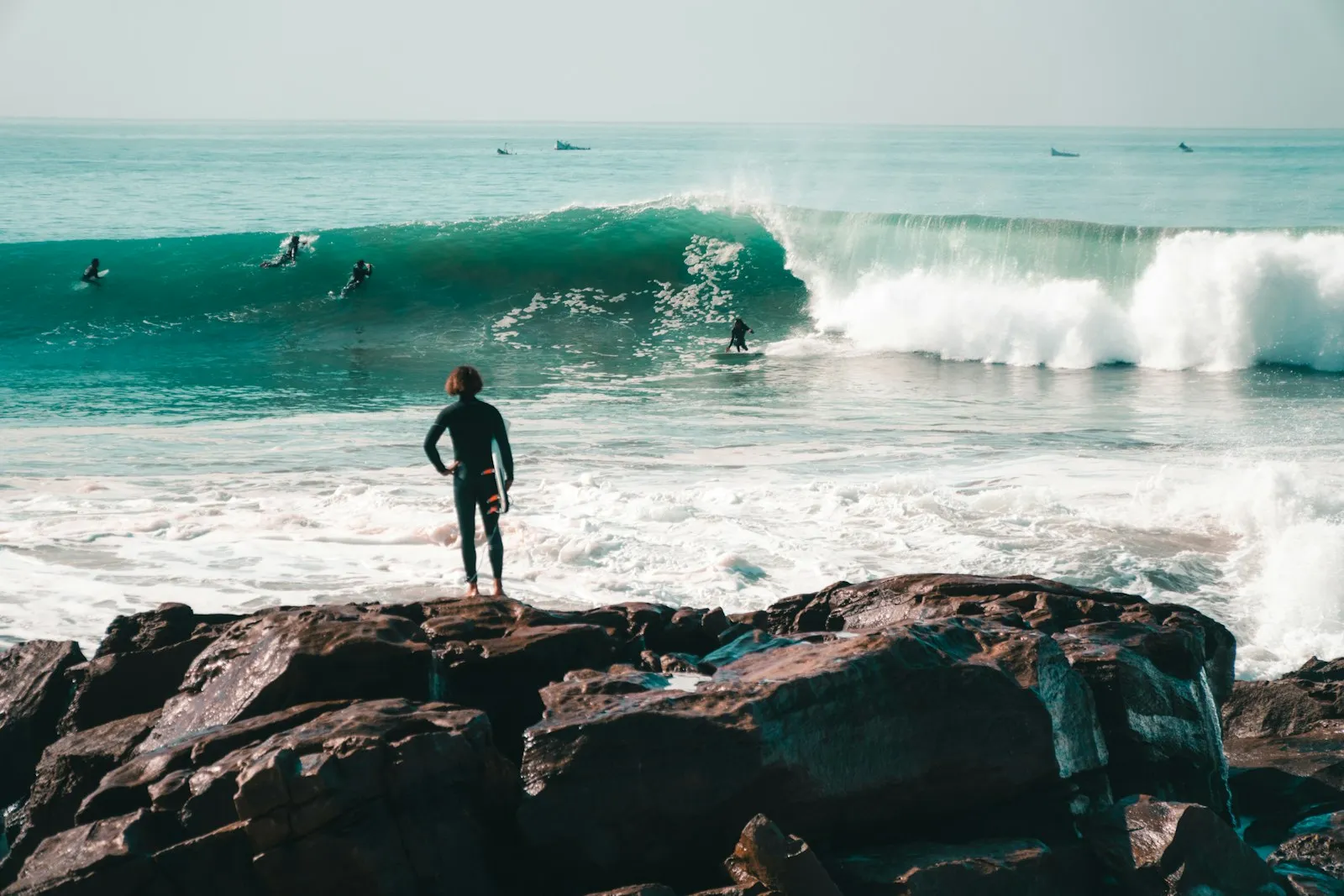
Can you really work remotely from Imsouane?
Yes, if you plan your connection rather than relying on luck. Imsouane is a small working fishing village on Morocco’s Atlantic coast, not a city with a coworking space on every corner. Most remote workers here use mobile data as their main connection and keep wifi, wherever they find it, as a backup.
What makes it work is the rhythm of the place. The surf is usually cleanest in the morning, and onshore wind tends to build after midday. So the ocean more or less tells you when to work.
Which SIM card should I buy in Morocco?
Morocco has three main mobile networks: Maroc Telecom, Orange and inwi. All three sell prepaid SIM cards with data packages that you can top up in small shops across the country. To buy one, you’ll usually need to show your passport so the number can be registered.
| Option | Where to get it | Setup | Relative cost | Best for |
|---|---|---|---|---|
| Local prepaid SIM (airport) | Operator desks at Agadir Al Massira, usually | Done for you at the desk | Lowest | Most remote workers |
| Local prepaid SIM (in town) | Shops in Agadir or Essaouira | Done for you in the shop | Lowest | People arriving by road |
| Travel eSIM | Online, before you leave | Install on your phone in advance | Moderate | Phones that support eSIM, or anyone who wants data from the moment they land |
| Roaming on your home plan | Nothing to buy | None | Highest, usually | Very short stays only |
Your phone needs to be unlocked to take a Moroccan SIM. If you want to keep your home number active for bank verification codes, a dual-SIM phone or an eSIM for data is the easiest way to do it.
Prices for data packs change often and vary by operator, so compare at the desk. The local option almost always gives you more data than roaming.
How good is mobile coverage in Imsouane?
In the village you can usually get a 4G signal, which is fine for email, messaging, shared documents and most video calls. Coverage depends on the building you’re in and gets less reliable as you head up the coast or out onto the more exposed parts of the headland.
A few practical points:
- Test your connection on your first day, before you have any important calls scheduled.
- Ask locally which network works best in the village, because one operator can do better than another depending on the area.
- Hotspotting from your phone uses data quickly. Buy a bigger package than you think you’ll need.
- Download files, maps and documents you’ll need offline while you have a good signal.
Is there wifi where I stay?
We confirm the internet setup at the surf house directly when you book, so we can tell you accurately what to expect on your dates. If your work depends on uploading large files or making long video calls, tell us when you get in touch by WhatsApp or email.
Wherever you stay in a small coastal village, it’s a good idea to treat wifi as one of two connections, not the only one. A local SIM in your pocket means you’re never stuck if the signal drops before a deadline.
How do I fit surfing around a working day?
It’s easiest to surf first and work afterwards. Magic Bay, Imsouane’s long right-hand point break, peels over sand for much of its length and is forgiving enough for beginners, so even a short morning session is worth it.
| Time of day | Usual conditions | What to do |
|---|---|---|
| Early to mid-morning | Cleanest surf, light wind | Surf, either on your own or in a 2-hour lesson |
| Late morning | Wind starting to pick up | Eat, shower, set up your workspace |
| Afternoon | Onshore wind, choppier surf | Focused work and calls |
| Evening | Sunset | Shared dinner on the rooftop, then a little more work if you need it |
Time zones: Morocco normally runs on GMT+1, but the clocks usually go back to GMT during Ramadan. Check the offset before you agree to meeting times with colleagues in Europe or the Americas.
If your team expects you online in the morning, it’s worth asking about moving your hours before you come. For most of the year the morning sessions are the best surfing you’ll get.
When is the best time to come as a remote worker?
It depends on your level. From September to April the north-west swell is at its most consistent, and December to February brings the biggest surf and the most people. From May to August the waves are smaller and better for learning, and the water is warmer, at around 20-23C. A 3/2 wetsuit is enough for most of the year.
What else should I pack for working here?
- An unlocked phone, ideally with dual SIM or eSIM.
- A power bank to keep your phone going while you use it as a hotspot.
- A plug adapter: Morocco uses European-style two-pin sockets.
- Noise-cancelling headphones for calls.
- Your own board and wetsuit if you’d rather bring them. You don’t have to, because boards and wetsuits are included in lessons and surf weeks.
For details we haven’t covered here, such as room setup or your exact arrival time, we confirm those directly when you book. You can find our contact details on the contact page.
If you want to surf one session a day around your work, take a look at our lessons. If you’d rather have the whole week organised, see our surf weeks. Rent a board or wetsuit by the day or the week on our rental page, and see our activities for your days off.