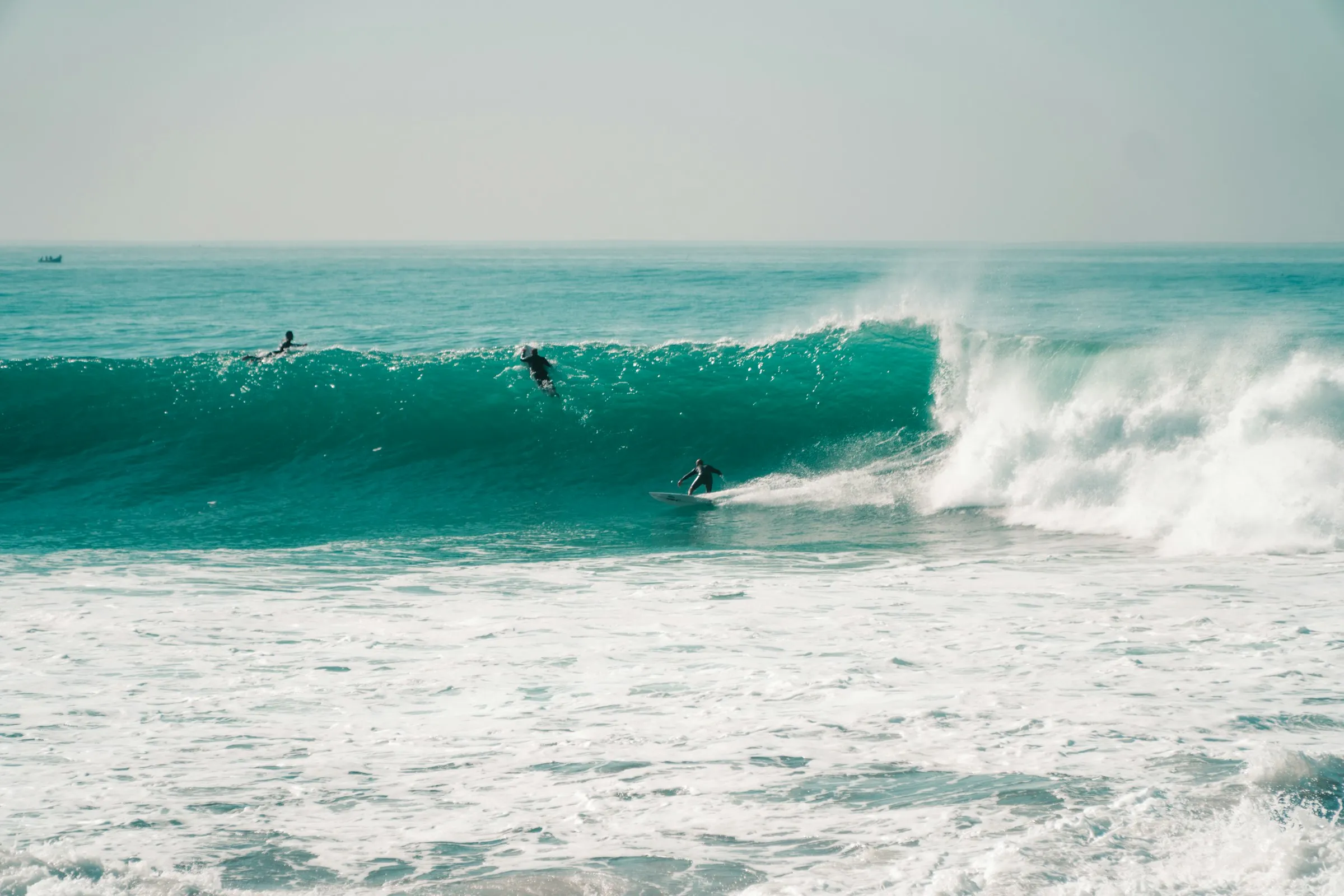
Why so many surfers stall in the white water
The white water pushes you. A green wave asks you to generate the speed yourself and to be in the right place before it arrives. That is why the plateau is so common: a surfer can stand confidently on foam for years and still miss every unbroken wave, because the skills that get you to your feet are not the skills that get you into a wave early.
In practice the plateau is almost always one of three things — paddling that stops the moment the wave lifts you, a take-off pointed straight at the beach, and sitting in the wrong spot on the peak. None of them are fitness problems. All three respond quickly to being watched by someone who can name what you just did.
Which drills actually move you onto green waves?
| Drill | What it fixes | How you know it’s working |
|---|---|---|
| Angled take-off — pop up already pointing down the line | Going straight, nose-diving, getting dumped | You come out of the pop-up already travelling along the wave |
| Paddle into the unbroken shoulder beside the foam | Fear of the green face; only committing once it has broken | You start catching waves before they break, not after |
| Three hard strokes after you feel the lift | Half-hearted paddling; needing a push | You catch waves without anyone behind the board |
| Eyes and head down the line, not at the board | Stalling, falling off the front | The board follows your gaze and you begin to trim |
| Line up off a fixed landmark on the point | Sitting too deep or too wide | More waves for less paddling in the same session |
| Trim first, turn later | Rushing a first turn and losing the wave | You make the section instead of falling in it |
None of these are exotic. What makes them work is doing them on consecutive days, on a wave that gives you enough time to get them wrong and try again.
How long does the transition take?
It depends far more on repetition than on talent. Five guided sessions inside one week will usually do more than five weekends spread across a year, because you are still holding the last correction when you paddle back out. Video helps for the same reason — most surfers are genuinely surprised by what their pop-up looks like, and a habit is easier to break once you have seen it.
Expect the first green waves to feel worse than the white water did. You catch fewer, you fall more, and your wave count drops exactly when your confidence needs it. That dip is the transition, not a sign that you have gone backwards.
Which lesson format suits which stage?
| Format | Duration and group | Video analysis | Best for | Relative cost |
|---|---|---|---|---|
| Group lesson | 2 hours, up to five surfers | Confirm when booking | First green waves with eyes on you | Lowest per person |
| Semi-private | 2 hours, two to three people | Confirm when booking | Friends or couples at a similar level who want more corrections | Moderate |
| Private coaching | 2 hours, one-to-one | Yes | Breaking one stubborn habit quickly | Highest per person |
| Kids lesson | 1h30, from age six | Confirm when booking | Children starting out | Confirm when booking |
Group size in the water is capped at five whatever the format, and our coaches are ISA-certified.
Which surf week suits which stage?
| Week (all 7 nights) | What’s included | Best for | Relative cost |
|---|---|---|---|
| Surf Camp Week | 7 nights in the surf house, 5 guided sessions, board and wetsuit | Making the step to green waves with steady daily repetition | Lowest of the three |
| Surf & Yoga Week | Everything in the Surf Camp Week, plus 5 rooftop yoga sessions, a traditional hammam and slow-food family dinners | Stiff paddlers and anyone who wants recovery built into the week | Higher — it adds yoga, hammam and dinners |
| Surf Development Week | Small-group coaching capped at five, daily video analysis, spot-chasing up the coast by 4x4, sessions on tides, theory and reading the line-up | Intermediate and up who have genuinely plateaued | Higher — it adds coaching, video and 4x4 transport |
Is Imsouane a good place to make the switch?
For this particular step, yes. Magic Bay is roughly an 800-metre right-hand point that peels over sand for much of its length, so the green face is long and comparatively forgiving — a wave that would be over in two seconds on a beach break gives you time to stand up and think. The surf house is about five minutes from the line-up.
| Spot | Bottom | Character | Who it suits |
|---|---|---|---|
| Magic Bay | Sand for much of its length | Long right-hand point, unusually forgiving | The white-water-to-green-wave transition |
| Cathedral Point | Rock | More powerful, on the exposed side of the headland | Confident intermediates and above |
| Up the coast toward Taghazout | Varies by spot | More than fifteen spots between Imsouane and Agadir, including Anchor Point | Development Week spot-chasing by 4x4 |
When should you come?
North-west Atlantic swell is most consistent from September to April, and December to February is the biggest and busiest stretch. May to August is the smallest and the best window for learning — which, for a surfer stepping onto green waves, is usually the right trade. Mornings are normally cleanest, as onshore wind tends to build after midday, so the useful sessions are early. Water runs about 17-20C in winter and 20-23C in summer, and a 3/2 wetsuit covers most of the year. The area gets around 340 days of sun.
When we are not the right choice
We are a family-run house rather than a hotel — two surfing brothers, Mhend and Mohamed, and their mother Aïcha, who bakes bread each morning and cooks the tajines. Meals are shared on the rooftop. If you want privacy, a front desk and to eat alone, that is a fair preference and we are not the right fit.
Imsouane is a working fishing village with a harbour where the boats land, so evenings are quiet. If you are chasing the heaviest surf of the year, that means December to February, and you should expect company in the bay. If you already surf green waves confidently, a standard group lesson will feel slow — book the Surf Development Week instead. And if you would rather coach yourself, renting a board and surfing on your own terms is a legitimate plan; it is simply the slower route through the plateau.
How do you book?
Booking is by WhatsApp or email, and we confirm availability the same day. A small deposit secures the week and the balance is settled on arrival. Send your flight details and we will arrange a transfer from Agadir Al Massira, about two hours away, or from Marrakech, about four. We speak English, French, German and Arabic. Prices, room details and anything else not set out here we confirm directly — just ask on the contact page.
If you are working on the transition, the drills above sit inside our surf lessons, and the consecutive-day repetition that makes them stick is what the surf weeks are built around. Bringing your own board is fine, and rental covers everything from soft-tops to shortboards if you are not. On flat afternoons, activities run from Moroccan cooking and surf-skate to Paradise Valley.