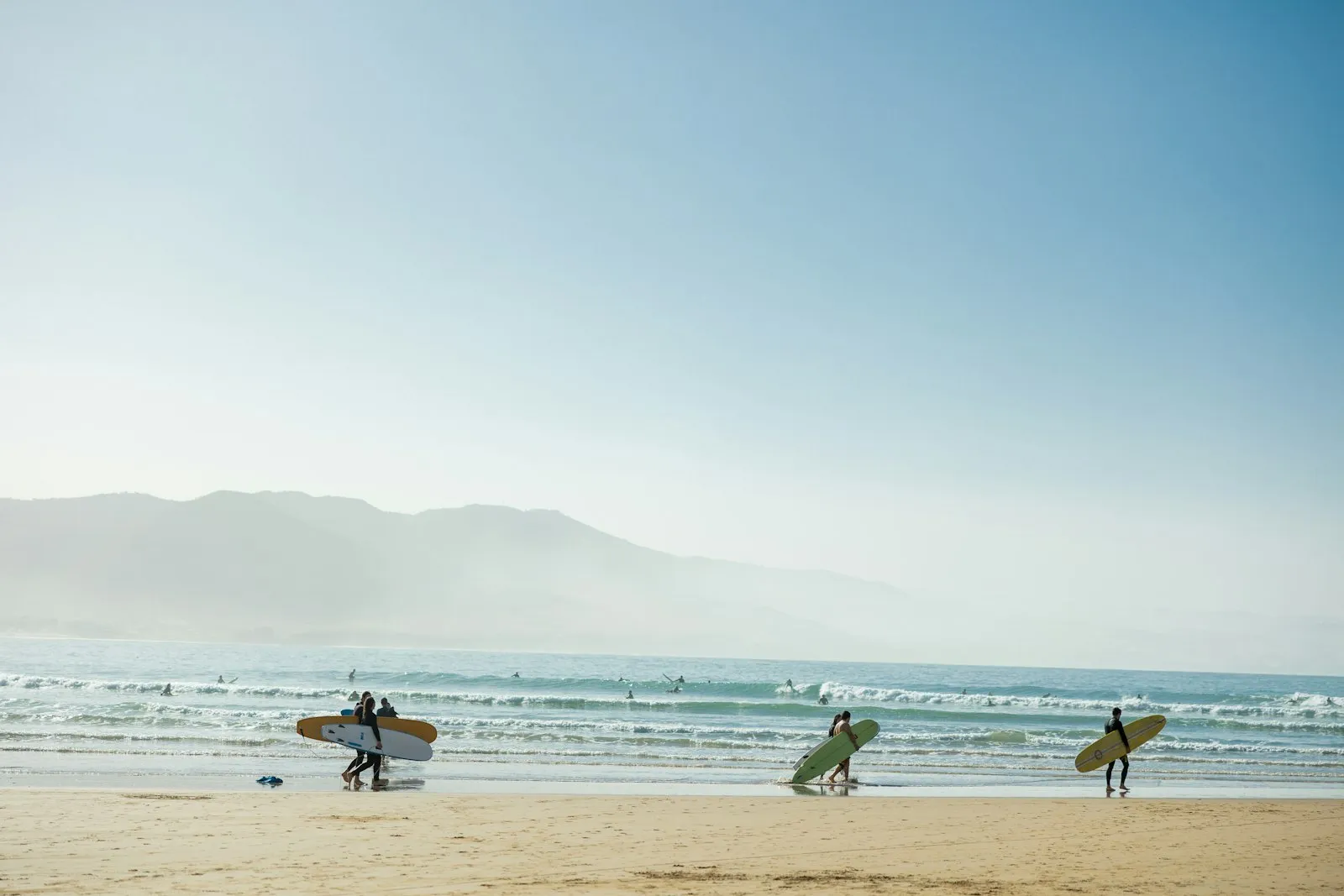
Almost everything written for beginner surfers is either intimidating or dishonest. This is an attempt at neither.
What actually happens in week one
You will spend the first session on the sand. Not because instructors enjoy delaying you, but because the pop-up — the movement from lying to standing — is far easier to learn on solid ground than on a moving board.
Then you go in, and you surf white water: waves that have already broken. The board is long, wide and floaty, which makes it stable and easy to catch waves on. Most people stand up during their first, second or third session.
That first stand-up feels like the finish line. It is not. It is the point at which the real learning starts.
The part nobody warns you about
Balance is rarely the limiting factor. Two other things are:
Paddling is exhausting. It uses shoulder and back muscles that almost nobody trains. Your first three days will end with genuinely tired arms, and that fatigue — not technique — is what usually ends a session.
Reading water is a skill of its own. Knowing where to sit, which wave is worth taking and when to start paddling takes far longer to develop than the physical act of standing. Good coaching accelerates it enormously; time in the water is the only real teacher.
Why Imsouane is a good place to start
Not all waves are equally kind to learners. A steep beach break gives you a fraction of a second to react. Imsouane’s bay does the opposite.
The wave here is a long, slow-breaking right-hander that rolls rather than throws. It gives you time — time to feel the board pick up, time to get your feet under you, time to make a mistake and recover from it. Combined with a sandy bottom on the inside, it removes most of what makes learning frightening elsewhere.
It is worth understanding what actually separates a forgiving learning wave from a punishing one, because the label “beginner-friendly” gets applied loosely:
| Wave type | Time to react | Bottom | Consequence of falling | Right for a first week? |
|---|---|---|---|---|
| Long point break (Imsouane) | Several seconds | Sand on the inside | Low | Yes — the wave does much of the work |
| Steep beach break | Under a second | Sand | Low, but heavy shorebreak tires you | Only when it is small and clean |
| Reef break | Under a second | Rock or coral | High | No |
| Rivermouth sandbar | Varies by day | Sand, shifting | Low | Sometimes — it depends entirely on the swell |
The pattern is simple: the longer a wave takes to break, the more of the learning it does for you. That is the whole case for starting somewhere like Imsouane rather than somewhere more dramatic.
What a day looks like
Sessions are built around the tide and the wind, not the clock. On a typical day:
- Early morning — the cleanest conditions, before the onshore breeze builds. The main session.
- Midday — food and rest. Surfing twice in one day is more tiring than beginners expect.
- Late afternoon — a second session on the right tide, or theory: wave selection, safety, etiquette.
A beginner week typically works out to ten to fifteen hours in the water. That is a lot of surfing, and by day four most people are ready for a rest morning.
What you need to bring
Almost nothing, in equipment terms. Boards and wetsuits come with the lesson or package. What genuinely helps:
- High-factor sunscreen, ideally a zinc stick for your face. The Atlantic reflects hard, and burnt skin ends trips.
- A rash vest for summer, to stop wetsuit and board rub.
- Warm clothes for the evening. Coastal Morocco cools sharply after dark, even in summer.
- Any medication you need, since Imsouane is a small village.
Etiquette, briefly
The line-up has rules, and beginners are forgiven for almost everything except ignoring them:
- The surfer closest to the breaking part of the wave has priority.
- Do not paddle for a wave someone is already riding.
- When paddling out, go around the break, not through it.
- Hold onto your board. A loose board is the most common cause of injury.
Being realistic
In a week you can reasonably expect to stand consistently in white water, catch some unbroken waves with help, and understand what you are looking at. You will not be surfing green waves confidently and unassisted — almost nobody is after seven days, and any school that promises it is selling something.
Surfing is unusually slow to learn and unusually hard to stop. That is rather the point.
We run beginner lessons daily in Imsouane and full surf weeks with coaching, board, wetsuit and food included. If you would rather practise on your own, we rent gear by the day and by the week.