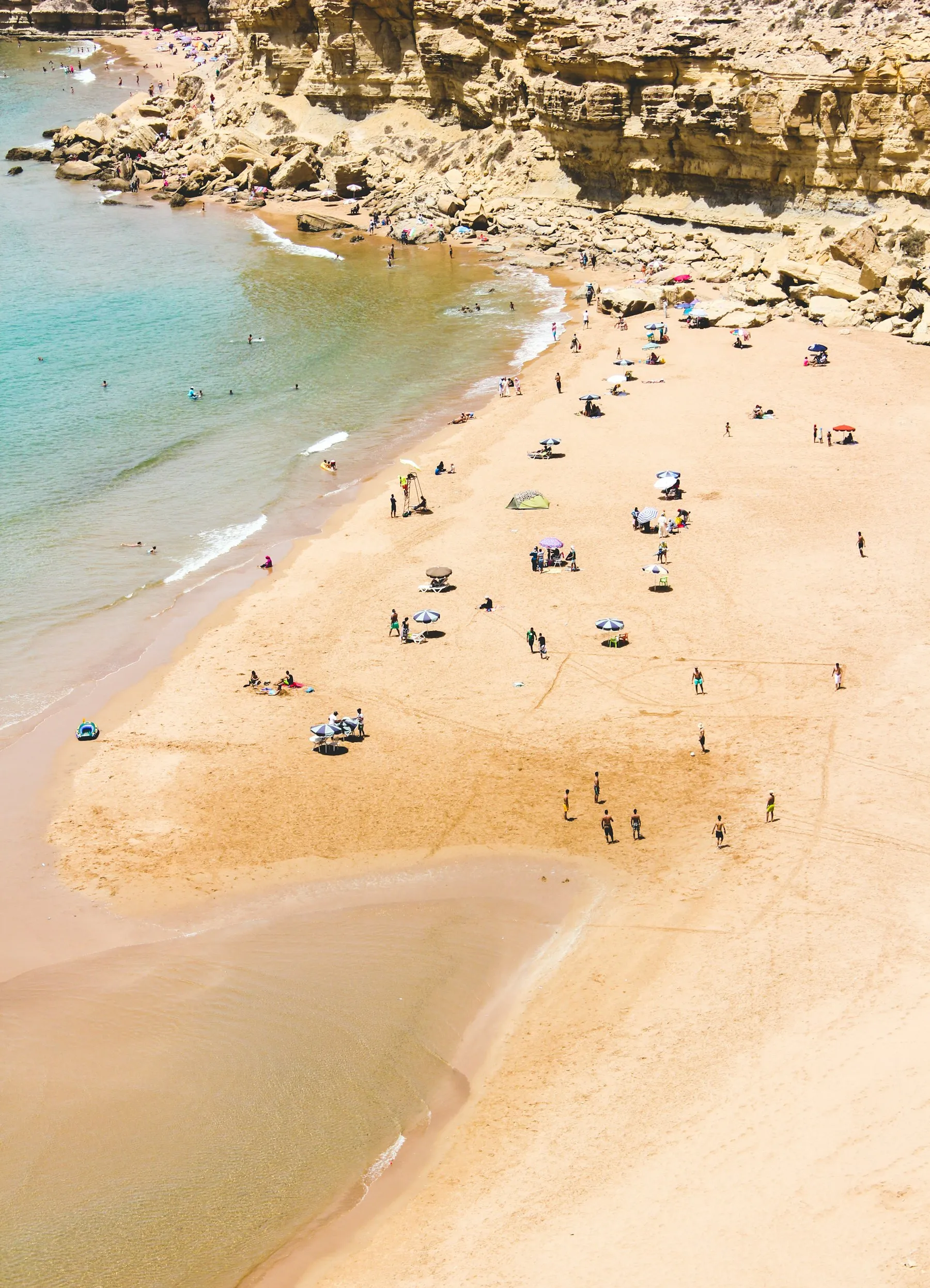
Where do beginners surf around Taghazout?
The stretch of coast north of Agadir, from Aourir through Tamraght to Taghazout, has several spots that suit new surfers. The four that come up again and again are Devil’s Rock, Panorama, Crocodiles and Banana Point. Each one suits a different level and a different tide, so knowing the basics of each will save you a wasted trip.
A general point first. These spots all change with the swell and the sandbanks. The tide guidance below is what usually holds, not a fixed rule. A local coach or surfer who checked the line-up that morning will always know more than any guide.
How do the beginner spots compare?
| Spot | Area | Wave type | Bottom | Suits | Best tide (usually) |
|---|---|---|---|---|---|
| Devil’s Rock | Aourir / Tamraght | Beach break, lefts and rights | Sand | First-timers and beginners | Works on most tides; often best mid to high |
| Panorama | South end of Taghazout | Right-hand break | Sand and rock | Beginners on small days, improvers | Mid tide |
| Crocodiles | Between Tamraght and Taghazout | Right-hander | Rock with sandy sections | Confident beginners and improvers | Mid tide |
| Banana Point | River mouth, Aourir | Slow right-hand point | Sand and rock | Beginners and improvers | Low to mid tide; needs a bigger swell |
Devil’s Rock: the easiest place to start
Devil’s Rock is an open beach break with a sandy bottom and peaks that break both left and right. On small to moderate days the whitewater rolls in gently, so you can practise standing up without worrying much about what’s under you.
It usually works on most tides, and many people find mid to high tide the most comfortable. Because it’s so reliable, it gets busy with surf schools. Give other people space, and don’t paddle into the middle of a lesson group.
Panorama: a right-hander for small days
Panorama is at the southern edge of Taghazout village. It’s a right-hand wave that peels along a mix of sand and rock. When the swell is small it gives beginners longer, cleaner rides than a beach break can. On bigger days it’s more of an improver’s wave.
Mid tide is usually the sweet spot. At low tide, the rocky parts sit closer to the surface. Booties are worth thinking about if you’re not sure where the rocks are.
Crocodiles: a step up
Crocodiles is a right-hander between Tamraght and Taghazout. It’s named after a rock formation on the shore. It suits surfers who can already paddle out on their own, catch unbroken waves and stay on their feet down the line. It’s a good next step once whitewater feels easy.
It’s usually best around mid tide. Watch for rock on the inside, especially as the tide drops. Pick your entry and exit before you paddle out.
Banana Point: gentle, but only on the right swell
Banana Point is at the river mouth in Aourir, the village people often call Banana Village. It’s a slow, soft right-hand point that suits beginners and improvers well. The catch is that it needs a bigger north-west swell to wrap in, so it’s often flat when other spots are working.
When it does break, low to mid tide is usually best. The water near the river mouth can be murkier after rain.
What about Anchor Point and the other famous waves?
Anchor Point at Taghazout is one of Morocco’s best-known right-hand point breaks, but it breaks over rock, has real power and draws a skilled crowd. It isn’t a place to learn. The same goes for the heavier reef and point waves further up the coast. There are more than fifteen surf spots between Imsouane and Agadir, and only some of them are safe for beginners.
When should beginners come?
| Months | Typical conditions | For beginners |
|---|---|---|
| May–August | Smallest swell | Easiest time to learn |
| September–November, March–April | Consistent north-west swell | Good, if you pick sheltered spots |
| December–February | Biggest swell, busiest line-ups | Harder; more spots are too big |
Whatever the month, mornings are usually cleanest. Onshore wind tends to pick up after midday. The water is around 17–20°C in winter and 20–23°C in summer, and a 3/2 wetsuit covers most of the year.
Is there a beginner alternative further north?
Imsouane is on the same coast, north of Taghazout. Its main wave, Magic Bay, is a long right-hand point break of roughly 800 metres that peels over sand for much of its length. It’s unusually forgiving, which is why beginners and experienced surfers share it. Cathedral Point, on the exposed side of the headland, is more powerful and breaks over rock.
Learning with us
If you’d like to learn in small groups, our lessons cap the group at five surfers. Our surf weeks include spot-chasing along this coast on the Surf Development Week. Boards and wetsuits are available through rental. For days out of the water, see our activities.